
Witch-king of Angmar: Difference between revisions
Red-link character article, book-canon (Corvus) |
Inject portrait (Wren) |
||
| Line 1: | Line 1: | ||
{{Infobox character | {{Infobox character | ||
| image = https://archmaester.site/portraits/lotr/witch-king-of-angmar.jpg | |||
| name = Witch-king of Angmar | | name = Witch-king of Angmar | ||
| title = Lord of the Nazgûl; Lord of the Ringwraiths; the Black Captain; King of Angmar | | title = Lord of the Nazgûl; Lord of the Ringwraiths; the Black Captain; King of Angmar | ||
Latest revision as of 21:32, 13 June 2026
| House / Order | None (once a king of Men) |
|---|---|
| Race / Culture | |
| Status | Destroyed |
| Origin | Angmar; Minas Morgul; Mordor |
| Born | Second Age (as a mortal king) |
| Died | Third Age 3019, at the Battle of the Pelennor Fields |
| Weapon | A great black sword and mace; the Morgul-knife |
| Fate | Slain by Éowyn and Meriadoc Brandybuck, fulfilling the prophecy that no man should slay him |
| Portrayed by |
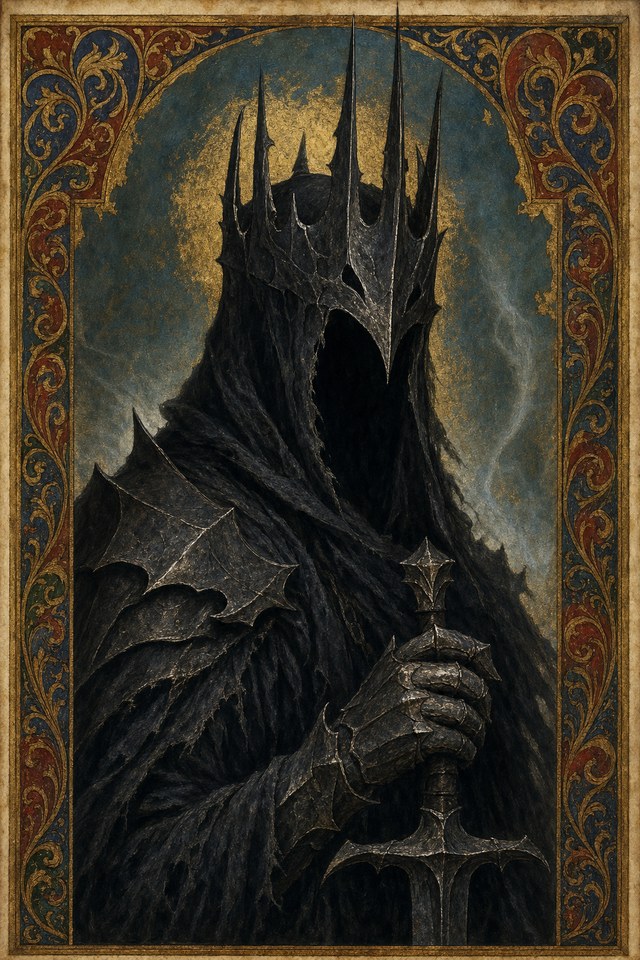
The Witch-king of Angmar was the chief of the Nazgûl, the nine Ringwraiths, the most terrible of Sauron's servants. Once a mortal king of Men corrupted by one of the Nine Rings of Power, he became a deathless wraith bound utterly to the Dark Lord's will, and as the Lord of the Nazgûl he was the deadliest captain of Mordor in the War of the Ring.
Background
In the Second Age, Sauron gave nine Rings of Power to nine lords of Men. One by one their bearers were ensnared by the Rings and faded out of the living world, becoming the Nazgûl, wraiths sustained beyond death and enslaved to the will of the One Ring and its master. Greatest among them was the Witch-king, a king of Men in life whose name was lost. He commanded the others as Lord of the Nazgûl.
Angmar and the fall of the North-kingdom
In the Third Age, the Witch-king founded and ruled the dark realm of Angmar in the far north, from which he made relentless war upon the divided Dúnedain kingdoms that had succeeded Arnor. Through centuries of conflict he destroyed them one by one, finally overthrowing the last northern kingdom of Arthedain and bringing the line of the North-kingdom to ruin. When at last a great army from Gondor and the Elves came against him and his power in Angmar was broken, the Witch-king fled. It was then that the Elf-lord Glorfindel uttered the famous prophecy that he would not fall "by the hand of man."
Lord of Minas Morgul
The Witch-king returned to Mordor and gathered the Nazgûl, and together they captured the Gondorian city of Minas Ithil, which thereafter became Minas Morgul, the Tower of Sorcery, his dread stronghold. From there he issued forth in the War of the Ring as Sauron's foremost commander.
The War of the Ring
The Witch-king led the hunt for the One Ring, pursuing Frodo and the Hobbits from the Shire. At Weathertop he stabbed Frodo with a Morgul-knife, seeking to make him a wraith, and at the Ford of Bruinen he and the other Riders were swept away by the flood. He returned mounted upon a winged beast and led the assault on Gondor, breaking the great Gate of Minas Tirith with spell and battering-ram, the one foe before whom even Gandalf stood ready to make a stand.
Death at the Pelennor
At the Battle of the Pelennor Fields, the Witch-king slew King Théoden of Rohan, crushing him beneath his fallen horse. The Lady Éowyn, who had ridden to war in secret disguised as a man, stood over the body to defend it. When the Witch-king boasted that no living man could hinder him, Éowyn cast off her helm and declared, "I am no man," and the Hobbit Meriadoc Brandybuck drove an enchanted blade of Westernesse, forged in the old wars against Angmar itself, into the wraith's knee from behind. As his power buckled, Éowyn thrust her sword into the empty space where his face should be, and the Witch-king passed shrieking into nothingness, undone at last, for he was slain by no man but by a woman and a Hobbit.
Character
The Witch-king is the embodiment of cold terror in the legendarium, a will of malice and fear given dreadful power, sustained by a Ring and a master and devoid of any self of his own. His destruction fulfills a prophecy spoken ages before and turns on the very pride of his boast, a fitting end for the chief instrument of Sauron's cruelty.
In the films
In Peter Jackson's The Lord of the Rings films, the Witch-king is a prominent antagonist, voiced and performed by several actors, with his death at the hands of Éowyn and Merry depicted closely after the books.