
Sauron
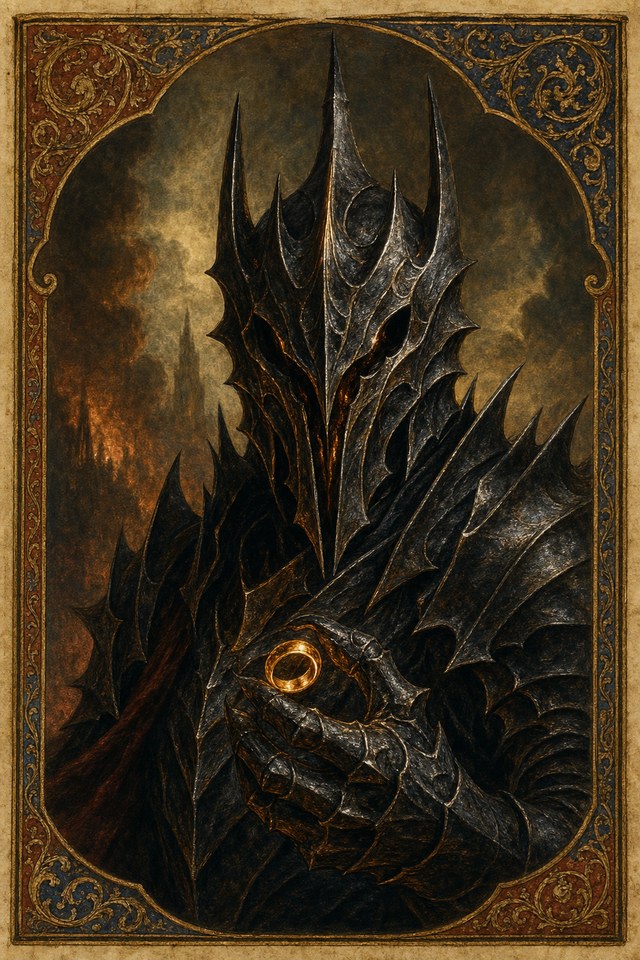
| House / Order | The Maiar of Aulë (formerly); servant of Morgoth |
|---|---|
| Race / Culture | Maia |
| Status | Slain (destroyed as a power) |
| Origin | Mordor; Barad-dûr; formerly Angband and Tol-in-Gaurhoth |
| Born | Before the shaping of the world (Maia) |
| Died | 25 March T.A. 3019, with the destruction of the One Ring |
| Weapon | The One Ring; the mace (in the Last Alliance); sorcery and dominion |
| Fate | Undone when the One Ring was unmade; reduced to an impotent malice unable to take form again |
| Portrayed by | Sala Baker (physical) / Alan Howard (voice) |
Sauron was the great Enemy of the Second and Third Ages, the Dark Lord of Mordor, and the maker of the One Ring. Originally a Maia of high power, he became the chief lieutenant of Morgoth, the first Dark Lord, and after his master's fall took up the work of dominating Middle-earth himself.
He is the antagonist about whom the whole tale of the War of the Ring turns. Having poured his native strength, will, and malice into the One Ring to bind the peoples of Middle-earth, he made his own existence dependent upon it — so that when the Ring was unmade in the Cracks of Doom, Sauron was destroyed for ever as a power that could act in the world.
Origins
Sauron was a Maia of the people of Aulë the Smith, named Mairon ("the Admirable") in his beginning, the greatest craftsman among his order. Drawn to order, efficiency, and control, he was seduced early by Morgoth (Melkor) and became his most powerful servant. In the wars of the First Age he was Gorthaur the Cruel, master of werewolves, lord of the isle of Tol-in-Gaurhoth, and a shape-shifter of terrible craft — it was Sauron whom Lúthien and Huan overthrew in the tale of Beren. When Morgoth was cast into the Void at the end of the First Age, Sauron repented in seeming but, unwilling to be judged, fled and hid.
Biography
The Rings of Power
- Main article: Rings of Power
In the Second Age Sauron set out to dominate Middle-earth by subtler means. Fair of form, he took the name Annatar, "Lord of Gifts," and taught the Elven-smiths of Eregion under Celebrimbor the craft of ring-making. Then in secret, in the fires of Mount Doom, he forged the One Ring to rule all the others, pouring into it much of his own power. The Elves perceived his treachery and hid the Three Rings, but the Seven and the Nine fell under his sway — the Nine making the Ringwraiths.
Númenor and the Last Alliance
Sauron's dominion grew until he was opposed by the Men of Númenor. Taken captive, he corrupted that kingdom from within, leading it to ruin in the Downfall of Númenor — after which he could never again take fair form. He returned to Mordor and warred upon the survivors, until the Last Alliance of Elves and Men under Gil-galad and Elendil overthrew him at the end of the Second Age. Isildur cut the One Ring from his hand, and Sauron's spirit fled, bodiless and diminished, but not destroyed — for while the Ring endured, so did he.
The Necromancer and the return
Through the Third Age Sauron slowly rebuilt his strength, first as a nameless shadow and then as the Necromancer of Dol Guldur in southern Mirkwood, until the White Council drove him out. He declared himself openly in Mordor, raised again the dark tower of Barad-dûr, and bent all his will to recovering the One Ring, which he believed lost. His searching presence in the latter days was figured as a great lidless Eye, wreathed in flame.
The War of the Ring and the end
Learning that the Ring survived and was in the hands of a Halfling, Sauron launched the War of the Ring to seize it before his enemies could use it against him. He never conceived that they would instead try to destroy it. While his attention was fixed on the armies before the Black Gate — drawn out by Aragorn's feint — Frodo, Sam, and Gollum reached the Cracks of Doom, and the Ring was unmade. In that instant Sauron's power failed utterly: Barad-dûr fell, his armies were scattered, and his spirit, stripped of the Ring, became a mere impotent malice, "a shadow... an ineffectual ghost" that could never again grow or take shape. So ended the Third Age.
Character
Sauron is the embodiment of the will to dominate. Unlike his master Morgoth, who craved destruction and the unmaking of all things, Sauron desired order — but order wholly subject to his single will, every other being reduced to a tool. He is rarely seen and never (in this Age) named with a fair face; his power is felt as dread, as the weight of his searching thought, and as the corrupting pull of the Ring. His fatal blindness is an inability to imagine that anyone would choose to destroy power rather than wield it.
Relationships
- Morgoth — his first master, the original Dark Lord, whom he served and outlived.
- The One Ring — his master-work and his weakness; his fate bound to it.
- Nazgûl — the nine Ringwraiths, his most terrible servants, led by the Witch-king of Angmar.
- Saruman — the Wizard he ensnared and bent to his service through the palantír.
- Celebrimbor — the Elf-smith he deceived and later destroyed.
- Isildur — who cut the Ring from his hand at the end of the Second Age.
Appearances
- The Hobbit (as the Necromancer of Dol Guldur, unnamed)
- The Fellowship of the Ring
- The Two Towers
- The Return of the King
- The Silmarillion ("Of the Rings of Power," and as Gorthaur in the First Age)
- Unfinished Tales
In Peter Jackson's film trilogy (2001–2003), Sauron was physically portrayed by Sala Baker and voiced by Alan Howard. The films render him chiefly as a flaming Eye atop Barad-dûr; in the books the Eye is a figure for his searching will rather than a literal beacon, and Sauron retains a physical form (described by Gollum as having only four fingers on the Black Hand).
Quotes
One Ring to rule them all, One Ring to find them, One Ring to bring them all, and in the darkness bind them.
The Eye was rimmed with fire, but was itself glazed, yellow as a cat's, watchful and intent, and the black slit of its pupil opened on a pit, a window into nothing.