
Denethor: Difference between revisions
Red-link character article, book-canon (Corvus) |
Inject portrait (Wren) |
||
| Line 1: | Line 1: | ||
{{Infobox character | {{Infobox character | ||
| image = https://archmaester.site/portraits/lotr/denethor.jpg | |||
| name = Denethor | | name = Denethor | ||
| title = Denethor II; Steward of Gondor; Lord of Minas Tirith | | title = Denethor II; Steward of Gondor; Lord of Minas Tirith | ||
Latest revision as of 21:32, 13 June 2026
| House / Order | House of Húrin (the Ruling Stewards) |
|---|---|
| Race / Culture | |
| Status | Deceased |
| Origin | Minas Tirith, Gondor |
| Born | Third Age 2930 |
| Died | Third Age 3019, in the Hallows of Minas Tirith |
| Weapon | — |
| Fate | Driven to despair through a palantír; burned himself alive on a pyre during the siege of Minas Tirith |
| Portrayed by |
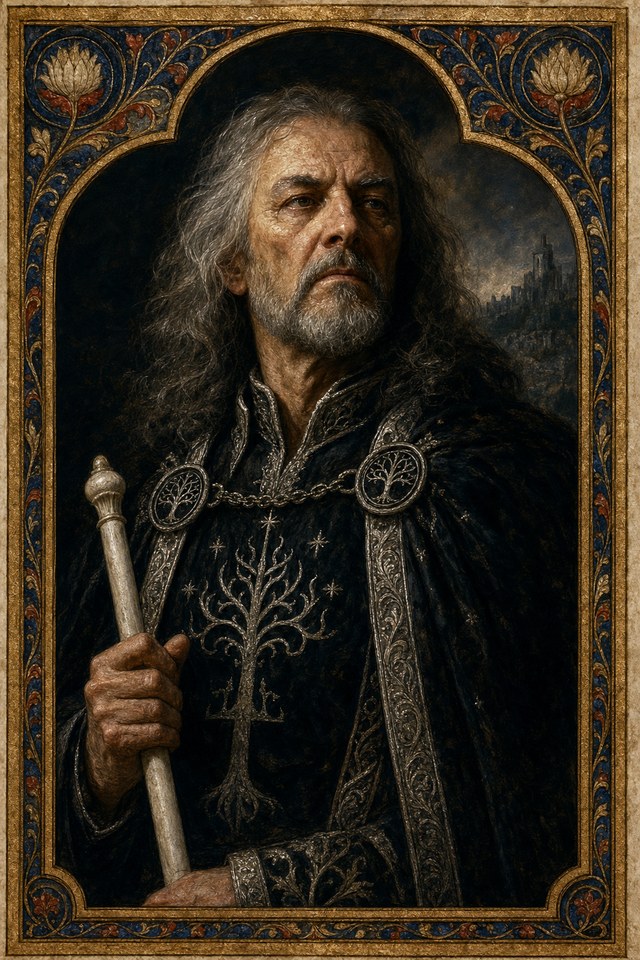
Denethor II was the twenty-sixth Ruling Steward of Gondor, lord of Minas Tirith during the War of the Ring, and father of Boromir and Faramir. A man of great mind and iron will, proud and far-sighted, Denethor was worn down and finally broken by his long, secret duel of wills with Sauron through a seeing-stone, and he ended in despair and self-destruction at the very hour of Gondor's deliverance.
Background
Denethor was the eldest son of Steward Ecthelion II and came of the line of the Ruling Stewards, who had governed Gondor for centuries in the absence of a king. He was accounted the most kingly in bearing and the most able of the Stewards in living memory, masterful, wise in lore, and of strong Númenórean blood. He married Finduilas of Dol Amroth, Finduilas, whom he loved deeply; her early death left him colder and more solitary, turning ever more inward in his cares.
Steward of Gondor
As Steward, Denethor bore the whole weight of the realm's defense against the growing might of Mordor across the river. He governed shrewdly and was honored by his people, but he favored his elder son Boromir, in whom he saw his own image, over the gentler, more thoughtful Faramir, a partiality that strained the younger son's heart.
In secret, Denethor made use of one of the palantíri, the Seeing-stones of Gondor, to spy out the movements of the Enemy and gain knowledge denied to others. This explained his uncanny grasp of distant events, but it came at terrible cost: Sauron, who held the master-stone, could not wholly deceive the strong-willed Steward, yet he could choose what Denethor saw, showing him ever the overwhelming strength of Mordor until the Steward's hope was poisoned and his spirit slowly crushed.
The War of the Ring and death
When Gandalf and the Hobbit Peregrin Took came to Minas Tirith, Denethor received them coolly, jealous of Gandalf's influence and wary of any rival to his authority. Grief-stricken by the death of Boromir and despairing of victory after gazing into the palantír, Denethor's mind turned to ruin. When Faramir was brought back gravely wounded and seemingly dying from the assault on Osgiliath, the Steward's last hope failed utterly.
Believing all was lost, Denethor resolved to die as he imagined the kings of old, and to take his son with him. He commanded his servants to build a pyre in the Hallows, the tomb-houses of the Stewards, and to lay the unconscious Faramir upon it to be burned alive. Only the intervention of Pippin, Gandalf, and the guard Beregond saved Faramir from the flames. Denethor, refusing all comfort and crying out his despair, set himself alight upon the pyre, clutching the palantír, and so perished even as the tide of battle turned and Gondor was delivered.
Character
Denethor is one of Tolkien's most tragic figures, a noble and powerful man undone by pride and despair. His greatness is real, but his refusal to hope, his presumption in matching wills with Sauron, and his rejection of the returning king Aragorn mark the corruption of stewardship into bitterness. His fall stands in deliberate contrast to the humility of Théoden of Rohan, who died fighting.
In the films
In Peter Jackson's The Lord of the Rings films, Denethor is portrayed by John Noble. The films heighten his unsympathetic qualities and omit his use of the palantír as the cause of his despair, but retain his attempt to burn Faramir and his fiery death.
Appearances
- The Return of the King
- The Two Towers (mentioned)