
Faramir
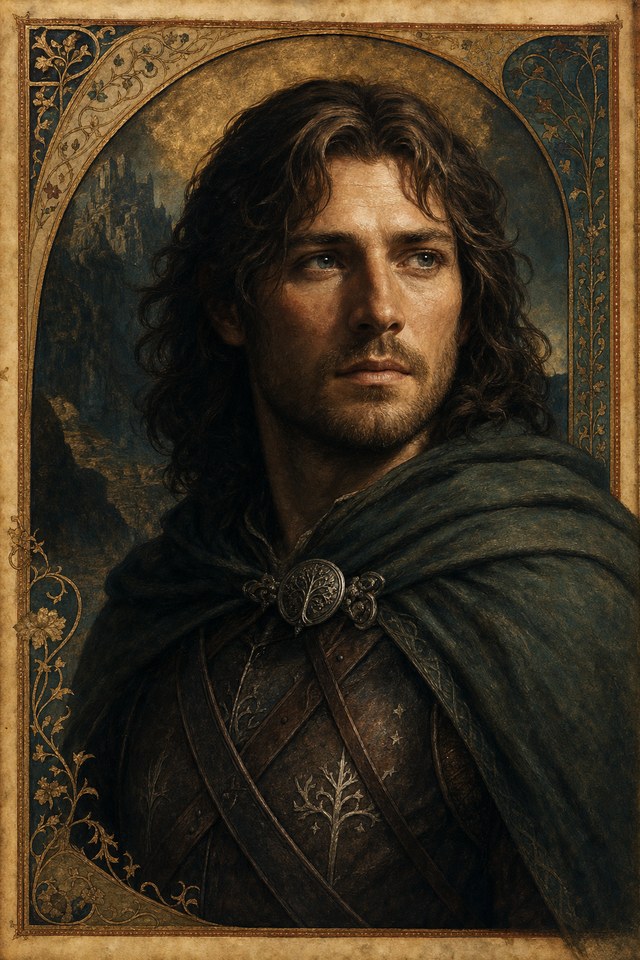
| House / Order | The House of the Stewards of Gondor; later the Princes of Ithilien |
|---|---|
| Race / Culture | Man (Dúnedain of Gondor) |
| Status | Survived |
| Origin | Minas Tirith and Ithilien, Gondor |
| Born | T.A. 2983 |
| Died | Fourth Age (year unrecorded) |
| Weapon | Sword and bow (Ranger of Ithilien) |
| Fate | Nearly burned alive by his maddened father; healed by Aragorn; wed Éowyn, made Prince of Ithilien |
| Portrayed by | David Wenham |
Faramir son of Denethor II was the younger son of the Ruling Steward of Gondor, Captain of the Rangers of Ithilien, and after the War of the Ring the first Prince of Ithilien. A wise and gentle captain, learned in lore and skilled in arms, he is the counterpoint to his brother Boromir — and the one man to hold the One Ring within his grasp and let it go freely.
His chief act in the tale is precisely that restraint. Encountering Frodo and Sam in Ithilien and learning what they carried, Faramir refused even to look upon the Ring, declaring he would not take it though it lay by the roadside — and so released the Ring-bearers to their errand, proving himself proof against the temptation that had broken his brother.
Origins
Faramir was born in T.A. 2983, the second son of Denethor II, Ruling Steward of Gondor, and Finduilas of Dol Amroth, who died when he was a child. His elder brother was Boromir, whom he loved and who loved him in turn. Where Boromir was the soldier and his father's favourite, Faramir was the scholar — a pupil and friend of Gandalf, drawn to history, lore, and music — and for this his father esteemed him the less. He grew into a captain of high courage nonetheless, beloved of his men, and led the Rangers of Ithilien in their secret war against the forces crossing into Mordor's borderland.
Biography
The Ring in Ithilien
- Main article: Henneth Annûn
Faramir and Boromir both received the prophetic dream that sent Boromir north to Rivendell. After Boromir's death, Faramir saw his brother's funeral boat pass down the Anduin and the cloven Horn of Gondor come to him. Soon after, his Rangers captured Frodo and Sam in Ithilien and brought them to the hidden refuge of Henneth Annûn. There Faramir pieced together that Frodo bore "Isildur's Bane" — the One Ring his brother had coveted. The law of Gondor and his own command should have compelled him to bring it to his father; the Ring's lure pressed upon him as it had on Boromir.
Faramir refused it utterly. "Not if I found it on the highway would I take it," he said, and would not so much as set eyes on it. He provisioned the hobbits, gave them his blessing, and let them go on toward Cirith Ungol — though he warned them darkly against their guide Gollum and the evil of that pass. In this he showed the "quality" his father lacked: the wisdom to know the thing was not to be used.
Despair of the Steward
Returning to the war, Faramir held the crossings at Osgiliath and the Pelennor against the assault of Mordor. Driven back and gravely wounded by a Nazgûl-dart and the Black Breath, he was carried into Minas Tirith seemingly dying. His father Denethor, already half-mad with grief and despair fed by the palantír, lost all hope. Believing Faramir doomed, Denethor sought to burn them both alive on a funeral pyre in the tombs of the Rath Dínen. Only the intervention of Pippin, Gandalf, and the guard Beregond saved Faramir from the flames; Denethor cast himself into the fire and died.
Steward, healer's gift, and Prince
Faramir lay near death in the Houses of Healing until Aragorn recalled him with athelas — the first proof, before the people, of the returning king's healing hands. Recovering, Faramir met Éowyn of Rohan, also healing there, and the two fell in love. As Steward he formally surrendered the rule to Aragorn when the King was crowned, and Aragorn confirmed Faramir in the stewardship and raised him to be the first Prince of Ithilien, lord of Emyn Arnen. He wed Éowyn, and they dwelt in the renewed and guarded land of Ithilien.
Character
Faramir is wise, courteous, and steadfast, a soldier who does not love war for its own sake but only the things it defends. His learning, his friendship with Gandalf, and above all his refusal of the Ring mark him as the truest heir of the old Númenórean virtue in Gondor — "a captain that men will follow... even under the shadow of the black wings." His relationship with his father is marked by quiet pain, for Denethor loved Boromir more and reproached Faramir even unto death; yet Faramir never wavered in duty or love. Tolkien remarked that Faramir was the character who most resembled himself.
Relationships
- Éowyn — whom he wooed and wed in the Houses of Healing, healing her despair and his own.
- Boromir — his elder brother, whom he loved and outlived.
- Denethor — his father, who undervalued him and nearly burned him alive in madness.
- Gandalf — his teacher and friend in lore.
- Frodo Baggins — whom he sheltered, trusted, and released against the law of Gondor.
- Aragorn — his king, who healed him and raised him to be Prince of Ithilien.
Appearances
- The Two Towers (Book IV)
- The Return of the King
In Peter Jackson's film trilogy (2001–2003), Faramir was portrayed by David Wenham. The films alter Faramir's defining moment, having him initially take Frodo and the Ring toward Osgiliath before relenting; in the book Faramir never wavers and refuses the Ring outright at Henneth Annûn, which is central to his character.
Quotes
War must be, while we defend our lives against a destroyer who would devour all; but I do not love the bright sword for its sharpness, nor the arrow for its swiftness, nor the warrior for his glory. I love only that which they defend.
I would not take this thing, if it lay by the highway. Not were Minas Tirith falling in ruin and I alone could save her.