
Beregond: Difference between revisions
Red-link character article, book-canon (Corvus) |
Inject portrait (Wren) |
||
| Line 1: | Line 1: | ||
{{Infobox character | {{Infobox character | ||
| image = https://archmaester.site/portraits/lotr/beregond.jpg | |||
| name = Beregond | | name = Beregond | ||
| title = Guard of the Citadel; later Captain of the White Company | | title = Guard of the Citadel; later Captain of the White Company | ||
Latest revision as of 21:32, 13 June 2026
| House / Order | None (a soldier of Gondor) |
|---|---|
| Race / Culture | |
| Status | Alive (at the close of the War) |
| Origin | Minas Tirith, Gondor; later Ithilien |
| Born | Third Age (date unknown) |
| Died | Fourth Age |
| Weapon | Sword |
| Fate | Spared by King Elessar for shedding blood in the Hallows, then honored as captain of Faramir's guard in Ithilien |
| Portrayed by |
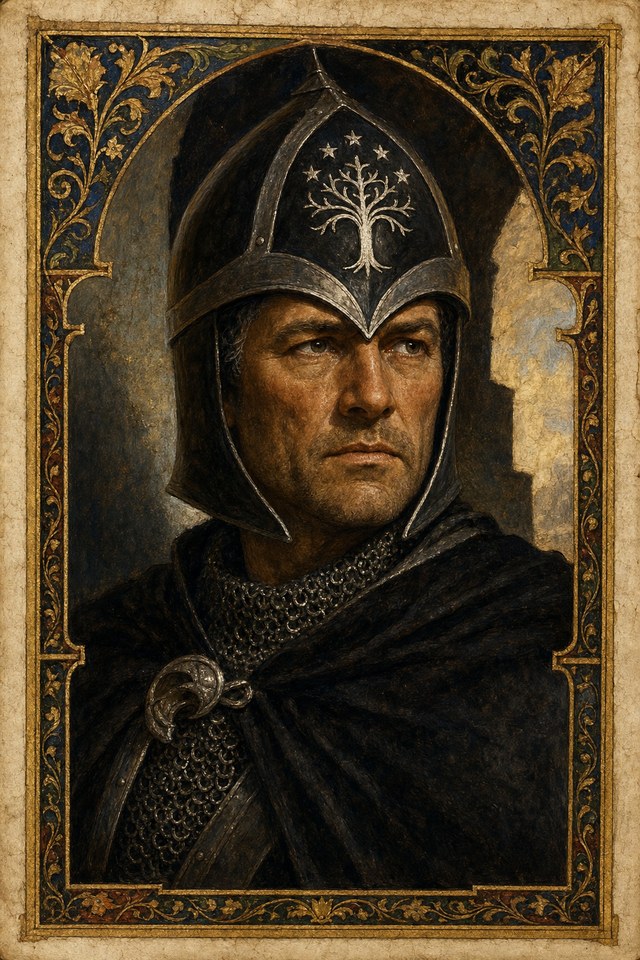
Beregond was a soldier of Gondor, a man of the Guard of the Citadel in Minas Tirith during the War of the Ring, remembered for the loyalty and courage that led him to break the law of his post in order to save the life of his captain, Faramir.
Background
Beregond was a common-born man-at-arms of the Third Company of the Guard of the Citadel, a soldier of long service and plain honesty, with a young son named Bergil. When the Hobbit Peregrin Took entered the service of the Steward Denethor and took up the black-and-silver of the Tower Guard, Denethor charged Beregond with instructing the newcomer in the ways of the Citadel. The two became friends, and Beregond showed Pippin the city and shared with him the fears and hopes of the men of Minas Tirith as the shadow of war drew near.
The siege and the Hallows
During the siege of Minas Tirith, the Steward Denethor, fallen into despair after the apparent mortal wounding of his son Faramir, commanded that a funeral pyre be raised in the Hallows, the sacred tomb-houses of the Stewards, and that the unconscious Faramir be burned alive upon it alongside himself.
Beregond faced an agonizing choice between his oath of obedience and his conscience. To save Faramir, he abandoned his post at the Gate without leave, slew the porter of the Hallows and others who barred the way, and held the door against Denethor's servants until Gandalf and Pippin could arrive and snatch Faramir from the flames. By these acts, though he shed blood in a hallowed place and deserted his post, capital crimes under the laws of Gondor, Beregond preserved the life of the future Steward.
Judgment and reward
After the War, when Aragorn came as King Elessar to give justice, Beregond's deeds were weighed. The King ruled that his crimes were balanced and outweighed by his valor and the life he had saved, but that he could no longer serve in the Guard of the Citadel, where his offenses had been committed. Instead, Elessar honored him: Beregond was made the captain of the White Company, the new guard of Prince Faramir of Ithilien, so that he might continue to serve and protect the lord whose life he had saved, in the fair land where Faramir would dwell.
Character
Beregond embodies the virtue of loyalty rightly ordered, the common soldier whose love and conscience led him to risk death and disgrace for what was right. His story poses the question of when duty must yield to a higher good, and Aragorn's wise and merciful judgment affirms that his choice, though unlawful, was honorable.
In the films
In Peter Jackson's The Lord of the Rings films, Beregond does not appear; his role in saving Faramir from the pyre is folded into the actions of Pippin and Gandalf.